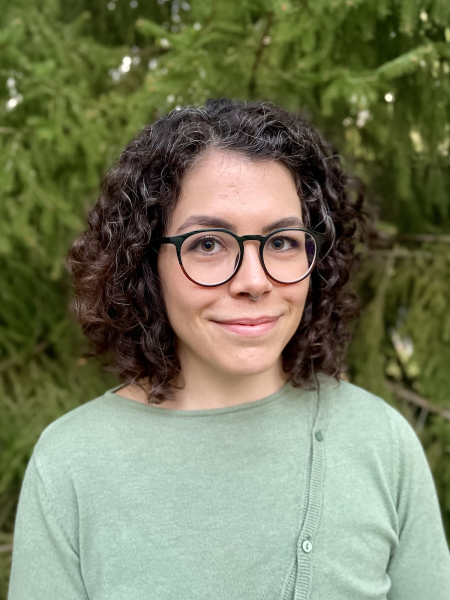
 Katie Dennis, assistant professor in the Department of Classical & Ancient Near Eastern Studies at the University of Wisconsin–Madison, has been awarded a Rome Prize fellowship from the American Academy in Rome, recognizing her as one of this year’s cohort of leading scholars and artists working across the humanities and creative fields.
One of the most competitive and prestigious awards in the arts and humanities, the Rome Prize is granted annually to approximately thirty fellows whose work demonstrates exceptional scholarly or artistic promise. Fellows receive residential support in Rome, including a stipend, private workspace, and full participation in the Academy’s interdisciplinary intellectual community.
Dennis is currently spending the spring semester in Rome as an Andrew Heiskell | Andrew W. Mellon Foundation Rome Prize Fellow, where she is advancing her project Songs of Subjection: Slavery in Vergil’s Eclogues.
Her project reexamines the Roman poet Vergil’s Eclogues, a set of pastoral poems traditionally understood as idyllic song contests set in an idealized rural landscape. Her research challenges that interpretation by foregrounding the ways Roman slavery shapes both the poems’ structure and their underlying cultural logic.
Rather than treating the Eclogues as detached from historical reality, Dennis argues that they are deeply embedded in the ideologies and practices of Roman slavery. By reading the poems alongside Roman agronomy, legal texts, inscriptions, and material culture, she traces how enslaved labor and systems of subjection inform the depiction of pastoral speakers and their ability to produce song.
“Songs of Subjection illustrates the mutual implication of slavery and cultural production,” Dennis writes in her project description, “revealing how biases derived from the practice and legacy of slavery can be traced in both the creation and interpretation of a text.”
Her work ultimately reframes the Eclogues as texts that not only reflect the realities of Roman slavery but also actively construct a poetic world shaped by hierarchies of power and subjugation. In doing so, Dennis contributes to broader conversations in classical studies about how ancient literature encodes systems of labor, domination, and cultural production.
As a Rome Prize Fellow, Dennis joins a multidisciplinary cohort of artists and scholars at the Academy, where fellows live and work in residence while engaging with Rome’s historical and contemporary cultural landscape.