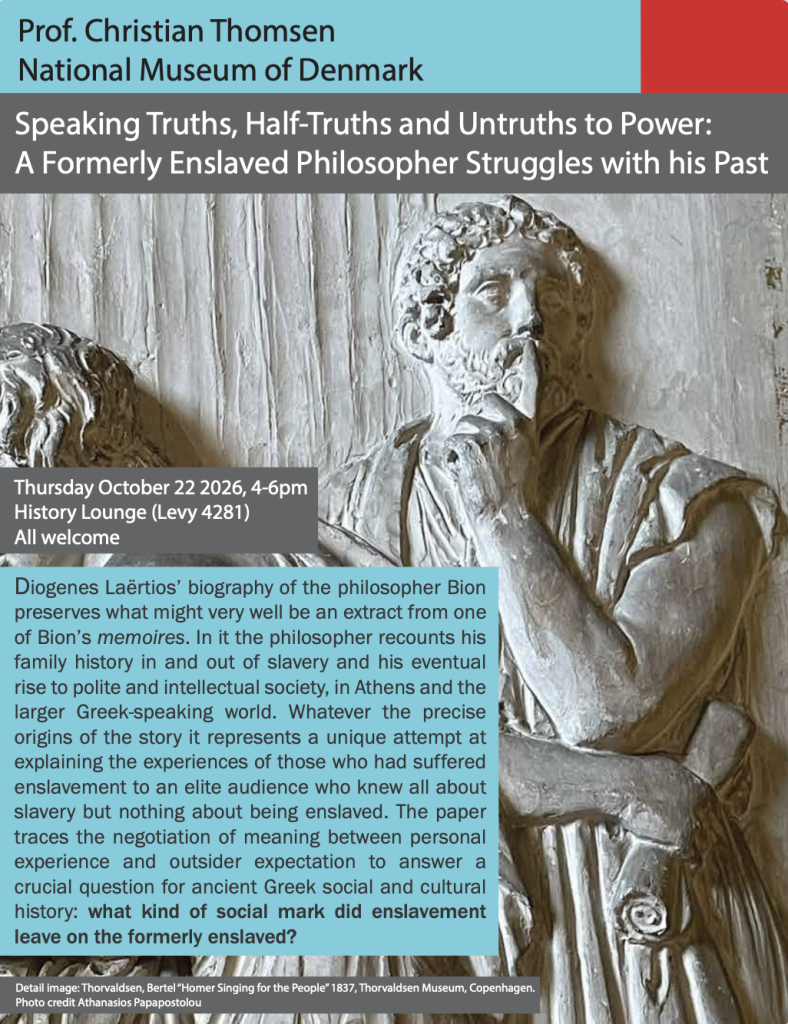
Diogenes Laërtios’ biography of the philosopher Bion preserves what might very well be an extract from one of Bion’s memoires. In it the philosopher recounts his family history in and out of slavery and his eventual rise to polite and intellectual society, in Athens and the larger Greek-speaking world. Whatever the precise origins of the story it represents a unique attempt at explaining the experiences of those who had suffered enslavement to an elite audience who knew all about slavery but nothing about being enslaved. The paper traces the negotiation of meaning between personal experience and outsider expectation to answer a crucial question for ancient Greek social and cultural history: what kind of social mark did enslavement leave on the formerly enslaved?
About the Guest
Christian A. Thomsen is a Research Professor specializing in ancient Greek social and political history, with broader interests in democracy, migration, slavery, and the development of city-states in the ancient world. His work brings together social and cultural history to explore how communities in ancient Greece organized themselves and negotiated power, identity, and belonging.
He is the author of The Politics of Association in Hellenistic Rhodes (2020), a study of civic and social networks in the Hellenistic period, and Stemmer fra Antikken (Ancient Greek Voices, 2024), which examines how voices from antiquity continue to resonate in modern discussions of society and politics. His research offers fresh perspectives on the complexities of ancient Greek communities and their relevance to contemporary debates about democracy and social organization.